Wednesday, July 5, 2017

Badass Women of History # 2: Molly Pitcher

Molly Pitcher: Two For One Special On American Patriotism
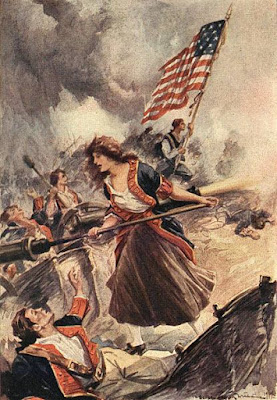
Well happy belated Independence day to you all. Just so you know I am working on a post for later this week were I will being exploring various countries Independence days, their origins and traditions. But first I want to give a big old salute to one of the folk-heroes of our own, which has almost all but been forgotten by the public, and shamefully hardly taught about anymore in our elementary schools, Molly Pitcher. Yes, the cannon loading inspiring figure of American female patriotism. So if she is so important why do I refer to her as a "folk-hero" instead of an actual living hero? Well that's because there was no one actually named "Molly Pitcher", the figure often depicted in paintings or whose name graces several rest stops, roads, buildings, and festivals throughout the states of New Jersey, New York, and Pennsylvania, is a composite of two different dutiful and patriotic women who showed their resolve in battle.

The first of our artillery wielding heroines is Margaret Corbin. Margret was the daughter of Scot-Irish colonists living in what is now Franklin County, Pennsylvania, in 1751. At 5 her farm was raided by Indians, her father was murdered and her mother taken of into the wilderness. Whether the attack was a random Indian incursion or orchestrated under the events of the recently commenced French-Indian war, no one knows. Margaret and her brother were thankfully not at home at the time, sparing them from the brutal natives attack. Now orphaned they went to live with an uncle in Virginia, were decades later she would marry a farmer by the name of John Corbin. When George Washington first forms the Continental Army, John signs up and is made a part of a cannon crew known as the 1st Company of Pennsylvania artillery. Margret would follow becoming a "camp follower", mostly wives, sisters, or mothers of soldiers who would do their wash, cook meals, and cared for the sick.

On August 27, 1776, Washington suffers a tremendous, almost crushing, defeat at the Battle of Long Island, also known as the Battle of Brooklyn Heights. The Continental army was under frontal assault by British forces under the command of Lord William Howe. Meanwhile, in a surprise move, a second army of British and German Hessian troops lead by Lord Charles Cornwallis came up from behind, pincering Washington's forces between them. Washington commanded a desperate retreat across New York harbor to Manhattan, while under fire from the cannons of the British Navy under the command of Lord Admiral Richard Howe (older brother of Lord William). Having just lost the vital harbor and most likely New York City as soon as Howe and Cornwallis cross, his aim was to evacuate as many soldiers he could, regroup and fortify White Plains. To that end Washington had two forts to cover his movements, Fort Lee and the more lightly garrisoned Fort Washington, which is were our young couple, the Corbin's, are to be stationed. But after another defeat at the Battle of White Plains, Washington had to cross the majority of his forces across the Hudson river and ordered the evacuation of Fort Washington. Colonel Robert Magaw, commander of the Fort, disagreed and has General Nathanial Greene intercede on his behalf with Washington, that he could hold the fort while Washington regroups in New Jersey. A successful attack by the forts artillery against two British warships heading up the Hudson River is enough to assuage Washington, but barely. It would turn out Washington should NOT have second guessed himself.


 An overwhelming force of British (lead by Lord Percy) and German Hessian (lead by Wilhelm Von Knyphausen) forces siege the fort on three sides on November 16. John Corbin was in command of a cannon crew on a ridge on the North-side of the fort, meanwhile Margaret would bring water and other supplies to them. During the battle the a Hessians' assault killed John, Margaret immediately took his place, making sure that the gun did not go silent, determined to make sure the Germans paid for every inch they gained. Before the fort finally surrendered, she would sustain shots to her arm, jaw, and chest. After recovery from her wounds, which never fully healed and would render her disabled, she was released by the British to her own recognizance where she would move to Philadelphia. There she would receive from the Pennsylvania legislature a $30 (almost $800 today) reward for her bravery  and a petition on her behalf to the Continental Congress for recognition of her service. In 1779 she is granted half the monthly pay of a Continental Army Regular, making her the first women in US history to receive a military pension. And in 1781 she would also be made a member of the Corp of Invalids, a group of wounded veterans who would be garrisoned and cared for at varies military bases and outposts; Margaret would be assigned to West Point, were she would receive a military funeral in 1800 and her grave/memorial can be viewed to this day.

The other great lady associated with the Molly Pitcher tale is Mary Ludwig Hayes. Mary's story is the one that is more well known of the Molly Pitcher stories, as the name, Molly Pitcher, comes from her tale and her time of recognition is at the famed American victory at Monmouth, New Jersey. There is dispute whether she was born in Philadelphia, PA, in 1744 or Trenton, NJ, in 1754, but what is known is she was the daughter of a butcher and that she would marry William "John" Hayes (another John? See why these tales can get mixed up), in Carlisle, PA, in 1777. We also don't know if John was a member of the Continental Army before or after he married Mary. But either way John is assigned to the 4th Pennsylvania Artillery (again, another Pennsylvania artillery unit just like our other tale) and ends up in Valley Forge with Washington. Mary followed as yet another "camp follower".

At Valley Forge John would train under the tutelage of Baron Von Steuben, the eccentric Prussian military advisor to Washington, helping him train common colonists to be proper soldiers. Mary would bring water to John's gun crew, not just for drinking but also to cool the cannon down. The story goes Von Steuben would accidentally (or purposefully in jest, who knows, he was a weird dude I plan on writing about eventually) call Mary Molly, yelling "Molly! Pitcher!". The name stuck with the gun crew. Her good nature and hard work endeared her to the entire 4th Pennsylvania Artillery unit and she would become their some what of an unofficial mascot.


After suffering several defeats in New York, enduring the harsh winter in Valley Forge, and being chased up and down New Jersey by Lord Cornwallis, Washington finally caught a break. After having captured Philadelphia, the British General Henry Clinton was ordered to immediately make haste for New York City. Word of an incoming French Fleet stoked fears of a direct attack on the British high command based in New York harbor. In his rushed march Clinton did very little to cover his movements or routes he would be taking. Washington tracked down the British army's rear and set to attack in what will be known as the Battle of Monmouth. After a failed initial, and sloppily arranged, surprise cavalry attack by Washington's 2nd Charles Lee, thwarted by the well disciplined troops of Lord Cornwallis, the cat was out of the bag and General Clinton turned his troops to engage in a proper battle. Lee's retreating troops ran straight to Washington who chastised him and relieved him of command. Washington sent a couple of his artillery up the nearby hill to his right, including the 4th in preparation when the British would arrive to his position. During the battle John would collapse from either wounds or heat stroke (it was around 100 degrees that day), again no one knows for sure. Mary immediately took over his post. Mary's and the other gunners' job to keep pressure on the British flank, not allowing them to maneuver around to Washington's rear. At one point a musket ball or small caliber cannon shot flew between her legs tearing off the bottom half over skirt, she commented on her luck saying, "Well, that could have been worse" and continued on. This part of the story has been corroborated by several other soldiers in their diaries or reports. After the victory Washington himself would inquire about the woman he saw loading cannons. When he met up with her he promoted her to sergeant and let her stay on as part of the artillery crews.

After the war she moved back to Carlisle where her husband would pass away shortly after. She would eventually remarry a friend of her husbands and fellow revolution veteran, John McCauly. Unfortunately, it's strongly suspected that this was not a happy marriage and the new John would lead her to financial ruin (including losing a 200 acre tract of land left to her by family due to his debts). But her reputation would not he dragged down by her new husband, as Mary was lovingly referred to around town as Sergeant Molly and treated like a celebrity throughout PA. The well to do would flock to hire Sergeant Molly as a private nurse for their sick loved ones or nanny for unruly children were she would play up her image as a no nonsense, regimental, soldier-mouthed governess, much to the delight of her patrons. In 1822 the Pennsylvania legislature would award her with an annual pension of $40 ($770 today) for her service. In 1832 she was given a state funeral in Carlisle, where her grave states Mary McCauly, but the monument behind it says Molly Pitcher.

Happy Independance Day


Love the British sense of humor, this is what the British embassy in Washington tweeted on Independence day. I find it remarkably wonderful how close our two peoples have become over the centuries. At the risk of bringing up the cliche, America and Great Britain truly do share a special relationship. I see it metaphorically as the rebellious teenager conflicting with a parent looking to find his own place and identity in the world, just to come back after years of self reflection to make amends with that same parent; not to go back to the way things were, but now with a mutual respect, love, and friendship.

Monday, July 3, 2017

History at the Movies #1: 1776

1776: The Director's Cut (or as I say "You can keep your rapping Hamilton")


Yesterday I watched one of my favorite musicals in the historic landmark Byrd Theater in the Richmond's Carey Town (http://byrdtheatre.com/), a movie house that hearkens back to the days of the eloquent theaters of yester-year. If you want a truly unique movie going experience I highly recommend a visit to this step back in time which is a fun and inexpensive destination that plays all sorts of movies from every era of film. But this post is not about that gorgeous theater, but about what played at 2pm on July 2nd, the musical 1776.

It has become a tradition of mine that at some point around this time of year, as we celebrate our nations birthday, to watch this wonderfully fun and surprisingly historically accurate musical. Which BTW, yesterday was the first time I ever got to see it on a big movie theater screen, instead of my TV at home, so that was kind of awesome. Long before Hamilton raped his way into millennials' hearts (which I have something to say about how the current trend of appropriating the figure of Hamilton for use in modern political views is kinda foolish, but more on that another time) came this gem. The film, adapted from the award winning Broadway play, centers around John Adams's struggle to convince the 2nd Continental Congress that the only logical goal of their current conflict with Britain was to win full independence for the colonies, and the only way to do that was to enlist the help of the scheming Dr. Franklin and the remarkable writting skills of Thomas Jefferson. Believe it or not to the majority at the time it was felt the fight being lead by Washington was merely to win some concessions from King George and Parliament, that the very idea of independence for the colonies was radical or inconceivable. But a Declaration of Independence, Adams, Franklin, and Jefferson insisted would "...to place before mankind the common sense of the subject, in terms so plain and firm as to command their assent..." (Thomas Jefferson)

The movie is just, in one word, fun. The music, the quips, and its humanizing of the founders, epitomizes how I feel history should be taught. Although it is a musical, what makes this more legitimate historically then most period pieces set in revolutionary America, is the fact that the vast majority of the dialogue, including the lyrics to the music, are all taken from primary sources. Minutes from sessions of Congress, diaries and correspondences from all that were there, speeches and editorials of the time, all used to create accurate depictions of the founders, their thought and views, their ideals, fears, and arguments, all brought to life beyond just reading their names in a text book. And with just a touch of creative license this men so important to the creation of our home are brought to life in a fun and sometimes all to human way; as Dr. Benjamin Franklin will put it, commenting on how posterity will view them all "what do you want them to think, that we were demi-gods; we are men, nothing more, just trying to do the best we can."

The stand out star of the piece is William Daniels as John Adams; yes the same Daniels that would voice KIT from the 80's action show Knight Rider, but you may also know him as Mr. Feny from Boy Meets World (and a handful of episodes of Girl Meets World). In fact his portrayal of the famed history teacher is directly influenced on how he play passionate, straight and narrow John Adams. Another outstanding performance is by Howard Da Silva, who brought to life Dr. Franklin. What makes his portrayal so significant? The production did not shy away from showing Franklin's less extolled qualities. Sure he was a man of respected wisdom and inventiveness, and the movie does pay appropriate homage to those traits, but it also shows Franklin as the carousing individual our texted books would like to wash away. His love of wine, woman, and song; a elderly man that sometimes had the mind of college frat boy. I would also like to give a quick honorable mention to the appearance of Gwyneth Paltrow's mom Blyth Danner, of Meet the Parents and Meet the Fockers, who plays the lovely Martha Jefferson.

Also, you may have noticed I distinguish the "director's Cut" version. Besides having a little more of that aforementioned cherished and true dialogue, it has one additional song I find to be highly important, "Cool, Considerate, Men." It is the song of the opposition, the loyalist, I think it is important that their voices be heard too. As Franklin would say late in the story, while chastising Adams for his sometime overbearing self righteousness, that (paraphrasing) these men have every right to be here and make their opinions heard as Adams, that like Adams they too are accomplished men who were duly elected. And that just because you don't agree with them doesn't mean, or give you the right, to ignore them, or blow of their concerns or ideals. It's one of the myriad of great points the show makes that transcends the period and resonates even in today's political climate.

So do yourself and your family a favor, rent this adorable movie from the the classic musical era, give it 2 hours of your time and I guarantee you will learn something about the founders you probably did not know before and have fun doing it. I leave you with some examples of the thought provoking melodies the movie has to offer

Friday, June 30, 2017

Badass Woman of History #1: Boudica

Boudica: Disney's Merida On Steroids (61AD)

When anyone mentions the subject matter of famous female warriors the first image that usually rattles off in peoples minds is Joan of Arc, that French knight of 100 Year War Fame. But for my series on kick ass female badasses I did not want to start with the cliche. Instead I chose to start with a woman who was down right savage in her response to sexist patriarchy and the defilement of her daughters; so bloody in her vengeance that the great halls of power throughout the Roman Empire shuddered at the name, Boudica. The name Boudica, or as later prounouced by Saxons, Voadicia, means victorious, and is one of the roots for the later name of Victoria. Now I know, I know, Disney's Merida is Scottish, not Briton Celt, and Merida is a princess with 3 brothers, not a queen with 2 daughters, but the resemblance and attitude has me questioning Disney's inspiration, in which I could not find any "official" connection. So instead of cartoon Scotland, our fiery red head's story begins in tribal Britannia, almost 115 years before her rise......

The Fosse Way

The Briton Celts had first encountered the Romans in 55BC when Julius Caesar crossed the channel during his war with Gaul (France). After a brief scrimmage and an odd display with a standard (see my posts about Caesar) the Romans left, but this did open up trade relations between the island and the empire. While goods flowed from the mysterious and foggy island, the Romans never stopped dreaming of northern expansion. Gallic tales, confirmed by Caesar, told of a land of lush forests, fertile fields, and hills ripe for mining. And after decades of delays due too internal strife, Emperor Claudius finally ordered the long awaited invasion in 43AD. It was slow at first as the Celtic tribes there were like no other people they had encountered before, even the Gallic Celts were not as good of woodsmen and guerilla fighters. But as Romans were known to do they played the game of setting tribe upon tribe, offering some chieftains status as kings of client states in exchange for aid in conquering those that defied the will of Rome. By 46AD the Romans were satisfied with the gains they had made and cut an enormous ditch across the land, known as the Fosse Way, to signify their new border, and let the world know that all lands east of the Way were under Roman "protection."
Iceni Territory

Enter the Iceni. They had been one of the 11 tribes that had allied itself to Rome and thus received the so-called autonomy of a "client state". They occupied an area within Rome's Fosse Way boundaries that is known today as Norfolk. Their relationship with Rome was amicable, the Romans enforced the peace between the tribes under its territory, and provided protection from the scheming Welsh tribes or the more brutish Scots and Picts. The Romans for the most part asked for nominally little: a couple of carts of food to feed their garrisons, sure they had plenty; some men to act as auxiliary forces at the border, sure they can do their part; lighten the weight of Iceni coins to devalue it for the good of the province's economy, now there is a problem. This request met resistance from the current Iceni chieftain/king, Antedi, and so a small insurrection to Roman rule started to bubble. But the Romans would nip it in the bud before it would grow, convincing the majority of the Iceni that their king was risking their autonomy for a few shavings of their coins that the common Iceni farmer or fisherman would never miss. So with the support of a Roman garrison the Iceni overthrew their king and replaced him with another of their own named Prasutagus, and with him came a new royal family; his wife Boudica and his two daughters.
Prasutagus and Boudica

The Roman governor of Britannia, Gaius Suetonius Paulinus wanted assurances from Prasutagus that he understood the Iceni partnership with Rome. So Prasutagus drew up a Will, where upon he named Emperor Nero his heir along with his wife and daughters, and that upon his death the emperor would be a rightful co-ruler of Iceni alongside his family. Like most Roman bureaucrats, Paulinus, was sucker for a good legal document and especially one that has such familial terms like "heir." Satisfied he left the Iceni to their enjoyed autonomy and sent a copy of the Will to Rome. But it was there that trouble would begin for our Celtic family.
Paulinus, Nero, and Seneca

Back in Rome, the capricious, immature, and often inebriated Emperor Nero had no real desire for the day to day running of the Empire. He much preferred day and night long parties and feasts, and playing his lyre for his "captive" audiences. He left the administration of his empire to a hand full of advisors, all of them looking to shape the empire to their own will and at the same time cut a profit for themselves. One of these (and would you believe the least evil of them) was Seneca, a Greek-Spaniard philosopher and teacher. He had found the copy of King Prasutagus's Will which had been sitting unopened among the stacks for sometime and doing some research on the Iceni tribe, he came up with a plan to cut quit a financial windfall for himself. The Iceni had borrowed money from Emperor Claudius back during the initial invasion of Britannia, but with the relative prosperity of the province no one bothered to collect. Seneca order the Procurator (financial officer) of Britannia, Catus Decianus, to approach the Iceni and tell them that Roman law does not permit woman from inheriting titles from men, and that they would dare see Boudica and her daughters, women, as equals of the Emperor was blasphemy. However, "Rome" would be willing to turn a blind eye to these infractions if the Iceni were to pay back their debts (at an absurd interest rate thought up by Seneca). 

During this pronouncement Paulinus was engaged in a war with the Northern Welsh and had not been informed of the Procurator's assignment, and by this time Prasutagus was deceased and Boudica was ruling as Queen.  She refused to pay until she could speak to Paulinus and stated under Celtic tradition wives and daughters were always entitled as heirs. Decianus had Boudica and her daughters arrested for inheritance fraud, she was taken by centurions (from Rome, not the local garrison) to the village of Norwich square and flogged. The centurions then proceeded to rape her daughters and plunder the village, to teach the Iceni a lesson about their "backward ways in accepting women rulers." 

The fact that Dedianus did not report his intentions to the governor, used outside troops, and then just left calls into question the legality of his and Seneca's actions. But none of that mattered Boudica and the Iceni. The Romans had disrespected their traditions and worse their queen, and had defiled the royal family. She called upon a neighboring tribe, the Trinovantes, to aid her, and spread the word to other like minded tribes that Romans had abused their authority and trampled on their heritage. Several tribes gathered into a make shift alliance and elected Boudica as their leader. She invoked the Celtic goddess Andraste, and in ritualistic fashion released a hare from the folds of her dress to divine wear the goddess would have them attack first. It ran in the direction of the Trinovantes former capital, Camulodunum (modern day Colchester), were the Romans had occupied and rebuilt it as a colony city and built a huge temple dedicated to deceased Emperor Claudius. 

Camulodunum and the Temple of Claudius

The city was filled with Roman traders, old legionnaire veterans, and families of the legionnaires now fighting with the governor in Wales. They had heard rumors of a large Celtic force headed for the city and asked Procurator Decianus to send reinforcements, but not seeing an army lead by a woman as a threat he sent only 200 auxiliary troops. Boudica arrived just outside the city and gave an impassioned speech to her army concluding....
"We Britons are used to women commanders in war; I am descended from mighty men! But I am not fighting for my kingdom and wealth now. I am fighting as an ordinary person for my lost freedom, my bruised body, and my outraged daughters... Consider how many of you are fighting — and why! Then you will win this battle, or perish. That is what I, a woman, plan to do! — let the men live in slavery if they will."
The Celts easily over ran the city defenses and dispatched the 200 auxiliary troops throughout the streets. They burned the building to the ground and tore down every monument and statute the Romans had erected to glorify their achievements. The last hold out was at the temple, what populace that were not killed or escaped into the countryside sought refugee within the marble walls, which the aged veterans now defended. For two whole days the veterans held out until they too were overwhelmed by the sheer number of attackers. All inside were slaughtered and the temple burned to the ground.
Boudica rides into Camulodunum on her chariot, the veterans last stand, and the burning of the temple

The Procurator sent the IX legion to relieve the city and aid the veterans last stand, but before they could reach the temple they too were surprised and numerically overwhelmed. Only a small detachment of cavalry lead by Quintus Petillius Cerialis Caesius Rufus, was able to escape with their lives. With the destruction of an entire legion, Dedianus could no longer keep this quick and quite, he had to tell Governor Paulinus....and Rome.

Boudica continued her march across the countryside, her army gaining strength and picking up followers with every village emancipated or destroyed. Governor Paulinus relieved Dedianus of his position and sent him back to Rome in disgrace while sending overtures to Queen Boudica to talk, as a "friend" of her late husband. But all diplomatic efforts were ignored. Paulinus made way to the new commercial center of Londinium (do you really need to tell you the modern day location) as this was right in the path of Boudica's army. Meanwhile back in Rome news of this barbarian queen's slaughter of Roman citizens and worse the embarrassing defeat of an entire legion and destruction of the temple. Emperor Nero was besides himself, he was already dealing with a new conflict with the Parthians, to have this woman and this good for nothing island cause him further grief was to much, and that it might be better just to forget Britannia all together. Agents of Paulinus begged him to reconsider and send reinforcements. Nero refused, but he also did not recall the troops already there either. He declared if the Britannia forces suffered one more defeat then the provinces would be abandoned.

Paulinus took the decree with grave concern. One more defeat? What does that entail? He had a good amount of forces, not as much as he would like, but it was something. Did the emperor mean another city falling to the barbarian horde or another legion? He made his decision, he looked at his surroundings and decreed trying to defending Londinium was not going to get him the victory he needed to keep his province. He abandoned the city to find a battleground of his choosing to face Boudica. After burning Londinium she would go on to pillage yet another Roman town, Verulamium (St. Albans). She then started to march toward the Roman fort of Manduessedum (Mancetter) and it was on the road, Watling Street that the two armies met; Paulinus's XIV and XX legions, and some auxiliary, 10,000 in total, verse Boudicas 230,000 strong horde.
Depiction of Boudica rallying her troops at the Battle of Watling Street

Paulinus chose a section of road that started to enter a dense forest and thick underbrush on either side to help negate Boudica's numbers, there the Romans stood as if guarding the entrance of the forest from the army rolling down the meadow in front of them. Boudica stopped her troops and from her chariot gave another impassioned speech on how they, man and woman side by side, were on the verge of freeing all of Brittania from the oppressive Romans. She ordered the first wave to charge, the Romans threw there pillas (heavy throwing spears) in response bringing down many, there bodies tripping up others. The rest of the Celtic forces charged in and the Romans formed into a wedge dividing Boudicas forces in half. Each half now was pushed up against the forest to their back and Roman cavalry up their flank. The Celts tried to back out the way they came to give themselves room to maneuver but ran right into their own baggage train and camp followers, their whole families which had been following close behind the whole march. With the Celts in disarray trying not to trample their own families the Romans reformed and marched straight through them. Celtic causalties numbered over 80,000, not counting children and non combatants that got caught up in the battle at the end. The Romans lost 400. Boudica would drink poison over the guilt she felt in endangering the children. As part of the agreement for complete surrender the Celts were allowed to take her body and given a lavish funeral.

Before the horrific events that lead to her revolt she ruled confidentially and without question. The fact that the Roman governor had no concerns about her place in the husbands will or the fact he tried to entreat with her after he was made aware of events shows that he knew and respected her as a competent leader, surprising for a man that came from a highly patriarchal society. Even her fellow tribal leaders looked past her gender and saw what was most important, the will and determination to lead. From time since British kings, queens, members of parliament, and prime ministers, including Winston Churchill himself, would invoke her name when extolling the tenacity of the British people to defend their homeland. Every depiction of her, every painting, documentary, and tale has her in the thick of battle, and the fact she successfully coordinated the sacking of 3 Roman cities and ambushed an entire Roman legion, and made an empire second guess itself, makes her one badass woman warrior.

If you would like to see (a depiction anyway) of the terrifiying Queen in action I recommend the History channels "Barbarians Rising", a great docu-drama telling the tale of four fearsome barbarians that shocked the Roman Empire:

Thursday, June 29, 2017

Badass Women of History Series

Hell Hath No Fury.....

In honor of the movie Wonder Woman, entering its 3rd record breaking week, I introduce to you the Badass Woman of History Series. At least once a month, possibly twice depending on the length of other posts, one of my posts here on Ancient Allen will bring to light the story of one of the myriad of remarkable women that defied convention and picked up the sword (or gun, or cannon,....) to become fearsome warriors as formidable on the battlefield as any of their male contemporaries. From either being cunning strategist, master swordsman, or sharpshooters, these ladies proved their mettle.

From the angelic Valkyrie of Norse legends to the stoic Amazons of Greek myth, there is precedent in the collective ideals of human civilizations of women warriors. This ideal has been put into practice again and again throughout all of history and across the world. And in varies aspects of warrorism; from armored maidens like Joan of Arc and Tomoe Gozen, warrior queens like Boudica and K'abel, to ruthless scoundrels like Sadie the Goat and Anne Bonny. Women so fierce, so powerful, and so numerous that even Joss Whedon and his writers would have a hard time keeping up. These women prove that sexism does not hold water, especially in the art of war.

So far I have a pretty expansive and diverse line-up, as listed below. The first up will be the Celtic Queen Boudica (top left in the above picture), who challenged the might of Rome and even had Emperor Nero questioning the empires future in the province known as Britannia, modern day England. From there the order is pretty fluid so if there is any particular one you would like to read about next or one you don't see on this list please let me know at ancientallen1014@gmail.com.

Tomoe Gozen - Samurai (top right)
Joan of Arc - French Knight (center)
Lozen - Apache warrior prophet (top center)
Rani Lakshmi Bai - Queen of India (middle left)
K'abel - Mayan Queen (middle right)
Pearl Hart - American Old West Outlaw (bottom left)
Nakano Takeko - Samurai (middle bottom)
Freydis Eirikdottir - Viking Explorer (bottom right)
Pantea Arteshbod - Persian Commander
Fu Hao - Queen of the Shang Dynasty
Grace O'Mally - Pirate
Trieu Thi Trinh - Vietnamese General
Nzinga - African Queen

and many more.....So stay tuned!
 

Wednesday, June 28, 2017

I Came, I Saw, I Blogged Part 4

Julius Caesar: Father To An Empire He Would Not See Born
(Years Covered: 47BC - 44BC)


Egypt stabilized and brought into the fold, Caesar and Cleopatra celebrated with a month long luxury cruise up and down the Nile. He was treated like a pharaoh of old and even had an open relationship with his new ally. Some back in Rome tried to use this to scandalize him, that he was fashioning himself a king and consorting with a pernicious foreign queen, dishonoring his wife. But again money talked, and the exotic wonders and wealth of Egypt were shipped to Rome to the amazement of the masses. The yet unknown rabble-rouser trying to defame Caesar's name was a young politician who himself had just arrived in Rome from Tarsus to take a seat in the Senate, Cassius. He was part of a new generation of young patricians that had studied the political philosophy of Cato and who had grown up outside of Italy looking to come back to the city of their forefathers to "set it right". Again Cicero saw an opportunity, he molded this new breed of senators to be more cautious and work in secret so as this new movement against Caesar would not be discovered before it was at strength.

Meanwhile, Caesar caught wind that the now "rebel" army had split into two; Pompey's two sons were in Spain raising more legions, while Cato and Mattlus were in North Africa and allied themselves with King Juba I of Numidia, the lands just west of old Carthage. Caesar again thought that with enough speed he could catch the two old senators by surprise, but when he got to the city of Thapsus they were waiting for him. Caesar arrived with 8 legions and 5,000 cavalry to find facing him a mixed Roman and African force of 12 legions, 14,500 cavalry, and 60 war elephants. Metallus lined his elephants in front of the legions and his cavalry at the flanks, hoping to trample Caesar's legions and have his legions just mop up behind or chase down breaking ranks. Caesar had his legions draw in close, with all archers fanned out on either flank. When the trumpets blared the archers aimed and maintained fire on the elephants, while the legions broke right or left to hold the line and protect the archers from cavalry. The elephants, under sustained arrow fire panicked and ran back away from the arrows right into Metallus's legions, trampling them. Once again, Caesar had defeated a numerically superior force. Shortly after Cato and Metallus would commit suicide rather then accept Caesar's hand of friendship.

 Caesar would return home to a Triumph (a military parade sanctioned by the Senate, like MacArthur got coming home from Korea) but he made sure to try an emphasize his victories in Gaul and Egypt as themes in the celebration, rather then the victories over fellow Romans. But Cassius and others made sure to whisper throughout the streets and halls of power that this celebration was as much about defeating the Senate as anything else. This malicious talk was starting to even catch the attention of Marcus Brutus, who was reminded on nearly a daily basis of his family's long legacy of defending Rome from tyrants. Adding fuel to Brutus's doubts about the man that had acted as father to him was the increased attention Caesar gave to Octavius; the jealously toward their relationship no doubt inflamed by his mother Servilla who herself had grown quit jealous of the tales of her long time lovers dalliances with the Egyptian queen Cleopatra. Caesar's will should have assuaged any feelings of complete abandonment Brutus may have had, as it named him second only to Octavian in inheritance, a great honor considering he was not at all a member of the Julia, which showed how much love he had for his unofficial step son. But all that was swept away with the arrival of Cleopatra in Rome bearing a baby, named Caesarean. And though it never did happen, many assumed and spat venom at the idea that Caesar would eventually change his will to include the "Egyptian half breed". Cassius and Cicero's propaganda machine worked over time, eroding the peoples image of Caesar; how he was under the influence of foreign sorceress and he would taint the purity of Rome with Egyptian culture. Again the long awaited reforms Caesar wanted to enact for the good of the empire were stymied by base accusations and obstructionism.

Though he was damaged he was not down. He was still able to use his vast influence and popularity to bring about such important issues as tax reform, land distribution, food programs, and to reorganize the provinces so they fell more under a unified system with Rome in the center instead of a hodgepodge of various degrees of autonomy and systems of governance. He even laid out the groundwork and proto ideas that would find purchase and bare fruit a decade or so later under the rule of great-nephew Octavius, the reconstruction of Rome and the idea of "bread and circuses". But his two significant acts as dictator: 1) to certify anyone living on the Italian peninsula as a Roman citizen, a point of contention since the city state of Rome had first started to expand and had even been the cause a few wars including the Social War fought by the generation before his; and 2) his long wished for slave labor reform, insuring that freeman could compete and find work so often taken up by slaves.

But Caesar was running into that age old paradox that it is far easier to win an empire then run one. The fact that his magnanimity to his former enemies seemed to only give him temporary favor with them, that now that he was home and not off fighting some battle diminished the people's awe of him, that the very idealism he championed was starting to peter out in the masses it was meant to help, all started to weigh on him.  The people needed to be reminded of why they loved him, he needed the image of Caesar the conqueror, not Caesar the politician. So he started to draw up plans for his once rejected Parthian campaign. It would be his greatest achievement, he would be glorified as the perfect Roman like Scipio Africanus or Romulus himself, and would usher in an age of Roman dominance across three continents. One final task needed to be complete before he could bring these plans before the Senate, he needed to remove all challenge to his rule, and that meant showing those in the Senate that any hidden hope they may have of the Pompey brothers in Hispania rekindling the resistance was gone. The final battles of the civil war must be fought.

Sextus and Gnaeus Pompey

Caesar had chaffed at the idea of going after his friend's last remaining sons, Gnaeus and Sextus, and fighting yet another battle against fellow Romans. But it could not be helped, in his mind they were the last rallying symbols of the conservatives. Little did Caesar know the seeds of a new generation of conservatives had been planted long ago and its poisoned fruits were already entrenched in the Senate, but I get ahead of my self. A force of 8 legions and 8,000 cavalry sailed to Spain. Caesar did not bother to bring any of his seasoned high ranking generals, instead he decided to bring two young men new to command as his subordinates. His heir Octavius and a friend of his, a young man of impeccable athleticism and a nearly unmatched skill with a sword in the western world, Agrippa. The two of them would become form friendship and partnership that would shape the world, avenging Caesar and making all of his dreams come true post-humorously. But that's a story for another time.

Agrippa

The Pompain army had taken most of Hispania Ulterior (Spain South coast) and had started to move into Hispania Citerior (east coast). Caesar's surprise arrival disrupted their siege of Ulipia, a town on the border of both provinces that was loyal to Caesar. Sextus would successfully base himself inside the city Corduba, meanwhile Gnaeus would engage Caesar in several small scrimmages, buying time until winter, when both armies would camp and regroup. As soon as the snows thawed Caesar tracked Gnaeus down to the hills outside the city of Munda. As the two armies approached each other both tried maneuvers and counter maneuvers to gain some sort of tactical advantage but to no avail. In the end when the swords started striking no side would be able to deploy some grand stratagem, it was an all out brawl. So all consuming was the battle that all the commanders, Caesar, Octavius, Agrippa, Gnaeus, and his second Titus Labienus, found themselves enveloped in furious hand to hand combat. And while Caesar would always be Caesar, known for his grand designs on the battlefield, it would be his youngers that shown the brightest, Octavius would start to earn his reputation as an awe inspiring figure men gravitate to; Agrigga would earn his vaunted reputation as a swordsmen and as soldier's soldier. In the end by sheer force of will and arms, Caesar's army prevailed, destroying the last vestiges of the rebel army. Titus would fall that day and be granted full honor funeral rights by Caesar. Gnaeus would be tracked down days later and killed and Sextus would flee to the islands of the western Mediterranean and not be heard from again for ten years during the next civil war, where he would act as naval support (engaging in acts of piracy, Pompey Magnus must have rolled in his grave, oh the irony) for Brutus, Cassius, and their ilk; he will meet his final defeat at the hands of Agrippa. Caesar would say of the Battle of Munda that he "fought many battles for the republic, but this was the first battle for my life."
Caesar fighting at Munda

Caesar would return to a very somber Rome, what good will he hoped for in officially ending the civil war evaporated as the reported death tolls came in, Romans were finally feeling the impact and the weight of the Roman dead these last few years. For the next few months he would try his damnest to get his Parthia project off the ground, but enthusiasm to see more Romans go off to war was at an all time low. There was still love for Caesar there, but how much more blood could they take. The answer came sooner then any could imagine. Cassius, Cicero, and Brutus thought they saw their opening, that the diminished love of the people would allow them to take a drastic step that would have the empire and history itself revere them as heroes. Oh boy they would be ssssooooooo wrong.

On March 15, 44BC, Caesar is called to the Senate to except the title of Dictator for Life, a title he hoped would give him the much needed boast to respark interest his ambitious eastern campaign. Antony had heard rumors of a plot against Caesar's life and raced to the Senate but was intercepted in the forum by a senator named Tribonius and his entourage, barring his path. Inside the Senate, Octavius was asked to step outside by another senator to discuss a private matter. Right on que a senator by the name of Tillus Cimber approached Caesar with a petition, asking that his brother's exile be rescinded. Other senators came forward to surround Caesar feigning support for the decree. At that moment a dagger was thrust toward Caesar's throat, who deflect it. Caesar grabbed at his assailant, Crasca, and demand to know what the meaning of the attack was. The other Senator's surrounding him pulled daggers and started to stab at him. Study of the body shows that he tried to fight them off, but with blood obscuring his vision he tripped and fell as they continued their assault. With tears and heartbreak in his eyes he looked at the one person he never suspected could do this to him, his unofficial step-son Brutus, and uttered his last words, "You too, child...", not Shakespeare's Et Tu Brute ("and you Brutus"). Sorry English Literature majors, I believe Plutarch over the Bard.

The assassins, calling themselves The Liberators, came out of the Senate a bloody mess and expecting cheers and adulation at the announcement of Caesar's death by their hands. What they got was a mob boiling in rage. The lower and middle classes still saw Caesar as their champion despite recent misgivings; the news sparked riots in the streets as calls for the heads of senators rang forth. The murderous senators scattered and fled to the safety of their estates. Antony and Octavius called for calm to prevent the city from imploding, and while no harm came to those who committed the act during the days of mourning and the reading of the will, the tension in the air was palpable. Since Brutus had been one of the conspirators, 18 year old Octavius was named sole heir, gaining half of all of Caesar's wealth and holdings, but more importantly the very name of Caesar. The other half of the fortune was granted to the people of Rome as Caesar says everything he did was to glorify them.The great Caesar's funeral was when things finally came to a head. The crowds, all wanting to honor their champion in some way, threw more and more objects unto the funeral pyre, at some points it almost got out of control, damaging the forum itself. The city at a tipping point, just needed a slight push. Antony railed not only against the so called "Liberators" but against the entire system of aristocrats, that the old Patrician family's had denied all of them their chosen leader. The crowds once again turned into a seething mob that marched on the houses of Brutus and Cassius. The Senate fled to the countryside as Antony declared a new Triumvirate consisting of himself, Octavius, and one Caesar's trusted cavalry generals, Lepidus, all three vowing to bring the aristocrats to justice and reform empire into a new glorious state. And to give even more weight to their cause, and with the unquestioning support of the crowds, they deified Caesar and called Octavius Divi Filius "Son of God" the one true ruler of Julius Gauis Caesar's Roman Empire. The Liberators had set out prevent a man from being crowned king, and in so doing created a God Emperor. And so the next Civil War began.

Phew, that took a lot long then I would have thought, but we got through it. But I am glad I could get one of my ideals out of the way. Not that all posts will be like these but I felt compelled to be extra thorough with big C. As you may have noticed throughout these last 4 posts I mostly stayed away from dates, statistics, and other empirical data, this is entirely on purpose. As I was trying to state in my very first post I believe in approaching history from a story telling perspective, when you get caught up in numbers and technicality that's when you fall asleep and miss whats truly important, the people and their stories. The other thing you may have noticed is my use of images from the HBO series Rome. The reason is not the TV show is the source material (that comes from a plethra of books, documentaries, websites, podcasts, and notes from collage) of these posts but the casting in that show is quite remarkable. If you were to look up the old busts and statutes of Caesar, Agrippa, Pompey, etc. the likeness the show achieved are astounding and I figure a reader would be better able to relate to a picture of someone then a dusty old cracked slab of marble. Overall I am quit pleased with how this turned out and I hope it was entertaining for you; and it would make me beyond delighted if I have created some new Caesar fan boys as well. So I hope you will all stay tuned and keep checking back. Again if there is any particular person, place, event, you would like me to write about please e-mail me at ancientallen1014@gmail.com and I will add it to my que of topics.


Little Turtles


Turtle Tactics

As we have been neck deep in Roman warfare with the likes of the Gallic war and Caesar's civil war, I came across this cute video on FB. In a later post I do wish to explore military tactics throughout history, such as the Greek Phalanx, Viking Berserkers, Scottish Schiltrons, and Roman Maniple. But for now here is a pretty good example of the Roman formation of the turtle, it used to get in close to an enemy firing ranged weapons at your melee foot soldiers.


Badass Women of History #7: Queen Tamar

Modern day Georgia There is large strip of land, just south of Russia proper, north of Turkey, and in between the Black and Caspian...