Wednesday, November 29, 2017

The Angevine Empire #1 (1154-1216): Overview

An Empire Forged and Preserved By Force of Will and Personality

From the epic of Ivanhoe, the tales of Robin Hood, and the iconic Third Crusade, a vast amount of our collective ideas and stories about medieval times is inspired by the less than 100 year time of the vast Angevin Realm; a time that was one of the markers for the end of the medieval era and into the Middle ages. Out of the fires of the horrific English civil war known as The Anarchy was forged a multinational British realm which many see as the prototype of the much later British Empire. The Norman kings of England, who still held titles and lands in France from the days of their ancestor William the Conqueror, would themselves conquer south Wales and the eastern half of Ireland; they would make the rest of Ireland and Wales, and the whole of Scotland client states, subordinating their kings to the Angevin crown. Even the mighty kings of France would not be able to enact any meaningful sovereignty over those lands controlled by the Angevins though the Norman lords of those lands were technical his vassals. 

Twin Capitals of Angers and Chinon
 From their fortresses in Angers and Chinon, France, the Plantagenet family ruled a multifaceted realm with strength and intrigue, fending off many outside challengers while trying to find ways to dethrone each other. And although the halls of power are a den of vipers, the outside world, to some extant, lives up to it's romanticized image: it is the age of the knight and the beginning of the ideals of chivalry, of deep christian devotion were the idea of making the 100s of mile journey to the holy land to fight the "heathen" Muslim hordes was a noble and valid way to cleanse ones sins; an age of troubadours and poets chronicling the deeds of great men. At least that's how the peasants liked to view it; as it was a welcomed low in the times of pillaging and burning commoners lands. The nobles, for a time, seemed content on attacking each other directly, besieging and counter sieging each others castles. And there was even room and opportunity for lowest of freeman to make some coin and have adventures of their own, if they were willing to "take the cross" and brave the journey to one of the christian strongholds of Outremer (small christian countries in the middle east that had popped up due to the events of the 1st Crusade).
Eleanor and Henry: Thee power couple of the age
The next couple of articles we will explore the events that shaped this realm, from its rise at the coronation of King Henry II to its disintegration under the inept rule of the villainous and incompetent King John; the constant on again off again wars with France; The aforementioned Third Crusade, also known as the Crusade of Kings, and the frenemy relationship between a Christian King and a Sultan of Islam; the scandalous murder of a revered clergyman; the start of the knightly pastime of tourneys; the beginnings of England's tumultuous relationship with Ireland; and the signing of one of the most important documents in western civilization, the Magna Carta.

We will also look at the great figures of the age, from the ruling dysfunctional Plantagenet family to their most trusted allies and bitterest rivals, though the two categories sometimes interchanged. Some of the personalities we will get to know are King Henry II, the skilled power broker and cunning founder who is one of the inspiration for the character of Tywin Lannister in Game of Thrones (top left); the legendary (and oft misunderstood) warrior King Richard the Lionheart (top right); the man historians have dubbed "The Greatest Knight" and the "Paragon of Chivalry", William Marshal 1st Earl of Pembroke (middle left); Saladin, the warlord that united the Muslim world (center); Saint Thomas Becket, once friend than political rival of the King, who was murdered in his own chapel (middle right), to name just a few. We will even cross over into our Badass Women of History Series as we look at the life of one of the most powerful and Machiavellian women in European history, Eleanor of Aquitaine, who played the game so well she could give Cersi Lannister a run for her money.

It is also an era of great debate among historians as views and interpretations of the people and events have shifted back and forth over the years. Was King Henry II complicit in Becket's murder? Does King Richard deserve his vaunted reputation and reverence? Was Saladin a pious and righteous defender of Islam or just a opportunistic warlord? Could the great rivalry between England and France, that lasted for centuries and sparked numerous wars, been prevented, and if so who is at fault the Plantagenet's or the Augustus' (French Royal family)? Was Magna Carta inevitable or just the reaction to the policy's of one bad King? How incompetent of a ruler was King John, does he truly deserve the scorn he receives to this day? Was Robin Hood a real historical figure or a fictional folk hero? Did Ireland and Scotland themselves pave the way for England's dominance over them, or was it pure English aggression? Welcome to the end times of the medieval that would shape the coming High Middle Age, and spawn a singular identity for England; just as the Saxons had done by shaking off their Nordic and Germanic connections, so to will the Norman English break its connections with France.


Wednesday, October 25, 2017

Michelangelo: Merging Catholic Devotion with Masterful Art

 "The true work of art is but a shadow the divine perfection"
Of all the artists in all the world and throughout history none have caught my eye, are as aesthetically pleasing, or filled me with such awe then Michelangelo di Lodovico Buonarroti Simoni. It is a life long dream, certainly a bucket list item, for me, to stand beneath and take in the beauty of the Sistine Chapel's ceiling, what I consider the most magnificent piece of art ever created. From the sculptures Pieta and David, the  masterpiece paintings of The Last Judgement and  The Crucifixion of Peter, to the architecture at the very heart of the Vatican itself, St. Peter's Basilica, his devotion to Catholicism is an indelible part of nearly his entire life's work.
The city of Caprese and the Coat of Arms of the Republic of Florence
Michelangelo was on born on March 6, 1475, in the Republic of Florence, one of the many small countries that made up the Italian peninsula, as Italy being one single nation was not realized until the mid 1800s.  Though he was born in the village of Caprese his family moved around within the Republic several times due to his father's shifting positions; from banker in Florence, Judge in Caprese, City Administrator in Chiusi, to quarry owner in Settigano. It was in this last location, where Michelangelo was living with his nanny and her husband after his mother's death, that he would develop his love of marble stone work. His nanny's husband, a stone-cutter at the quarry, would take six year old Michelangelo to work with him and teach him how to wield hammer and chisel to shape stone. But after several years his father was not pleased with his son's passion for manual labor and so at 13 had him shipped off to the city of Florence for schooling. His studies included grammar, math, and heavy doses of Humanism philosophy. 
Art and Architecture that influenced teenage Michelangelo
But he would routinely skip classes to go to Florence's many churches to try and copy the plethora of art displayed; places like Brancacci Chapel with its many painted frescoes of biblical scenes, the Church of Orsanmichele with its famous wall niche sculptures of saints, the architecture of the churches  San Lorenzo and Santo Spirito, and most of all the great bronze doors of the Florence Baptistery which Michelangelo called the "Gates of Paradise." When his father questioned him about his neglect toward his studies Michelangelo told him that his humanist teachers and the philosophy  of Humanism made him feel cold inside and detached from the beauty of the divine world. So after a year of formal studies his father paid for an apprenticeship with the artist Domenico Ghirlandaio, considered a master fresco painter and regularly commissioned by the Church and the powerful Medici family. It was unheard of that someone as young as 14 would receive such an apprenticeship but Ghirlandaio was greatly impressed by Michelangelo's copies, including of one of his own frescoes from the Brancacci Chapel. It was not long till Lorenzo de Medici, who at this point had become the de facto ruler of the Republic of Florence, asked Ghirlandaio for his two students with the greatest potential to attend his new Latin-humanist school, where some of the greatest philosophers and theologians of southern Europe were reconciling many of Plato's Humanist ideas with church teachings (much in the vain of St. Augustine). It is here, at the age of 16, that Michelangelo created his first original works, commissioned by Lorenzo de Medici himself, Madonna On The Stairs and Battle Of The Centaurs:
Michelangelo looked set for a meteoric rise in the art world at a very young age. However, his ascension would stall as Lorenzo died in April of 1492 and the protection afforded to Michelangelo from his patron seemed to go with him. Jealous of his talent and rise, his fellow students and apprentices started to harass and bully him, culminating in his nose being broken by contemporary, Pietro Torrigiano. He left the school and returned to his father's house taking odd jobs here and there.
Many of his works from this time have been lost or destroyed, or were temporary as in the case of a giant snow sculpture he did for a party hosted by Piero de Medici. To the left are some of the more famous ones that did survive. In exchange for letting him study cadavers for anatomical form at the church's hospital he carved a wooden crucifix for the Prior of Santo Spirito. He also created his famous Angel Of Christ Sculpture about which he said, "I saw an angel in the marble and carved until I set him free.". He was also commissioned by a Cardinal for a statue of the Greek god Bacchus, but upon completion the Cardinal refused to pay and so Michelangelo sold it to a Florentine banker friend of his fathers. And lastly he helped carve some of the figurines adorning the alter at the Shrine of Saint Dominic in Bologna. It was enough to keep him financial afloat and in practice. Its believed that it was during these years he developed his minimalist, almost monastic, ascetic lifestyle. He would later tell his pupils that to achieve greatness you must throw your entire life into your work, sacrificing comforts, "However rich I may have been, I have always lived like a poor man." His most famous apprentice said of Michelangelo, "he would eat more out of necessity than of pleasure. And often slept in his cloths and boots." Even before his great patronage with the church he was extremely devote and faithful, claiming all his talent was a gift from God, and in return must create great works to glorify him.

His time in obscurity would end and his career would once again take off in 1497. Cardinal Jean Bilhères de Lagraulas, the French ambassador to the Pope, commissioned him to create a sculpture depicting the mother/son relationship of Mother Mary and Jesus. In truth, the Cardinal and many of his associates were just expecting yet another piece of Mary cradling baby Jesus, as was a favorite subject among Italian and Spanish artists, but what they got was a masterpiece of an uncommon image that turned heads among the clergy. Michelangelo knew of the French and other Northern Europeans interest in non-biblical post crucifixion accounts, and so instead of Mary cradling a Jesus at the start of his life, he depicted the holy mother cradling him at the end. Further, instead of showing the wounds and torment of the passion upon Jesus's face, he wanted to show Jesus's countenance in a state of serenity that comes from being in a mothers arms. It was soon regarded around the whole of Western Europe as the worlds greatest sculpture with contemporaries giving accolades such as "a revelation of all the potentialities and force of the art of sculpture" and "It is certainly a miracle that a formless block of stone could ever have been reduced to a perfection that nature is scarcely able to create in the flesh." In art history it is considered one of the most important pieces of the Renaissance era as it is possibly the first example of an artist marrying to separate styles into one uniform piece, in this case both renaissance ideals of "Classical Beauty" and "Naturalism." Now, at 24, he had become a household name that everyone of import wanted to patron.

In 1473, famed sculptor Agostino di Duccio was commissioned by several trade guilds in the city of Florence for several statues of biblical prophets and heroes to line the roof of the Great Florence Cathedral. Agostino died in 1481 before completion, and whats worse is that hero the city identified itself the most with, King David, was not only unfinished but the piece of marble from which it was being carved had barley been put into human shape. After years of squabbling on what parts of the commission should be finished and at what price, in 1499, the Guild of Wool declared they would at least pay for the completion of David. Naturally their first choice was Michelangelo, who not only took on the project but completely redesigned the original plans to make it his own. It was completed in 1504 and both Botticelli and Leonardo da Vinci commented on how marveled they were on the technical skill of the sculpture, while they were on the committee trying to decide where in Florence David should be displayed. As David would be the symbol of Florence it was decided to be placed in the square directly in front of the Palazzo Vecchio, the main governance building. Today a replica stands in the spot while the original is on display in the Gallery of the Academy of Florence.

(Left) Michelangelo's Battle of Cascina (Right) da Vinci's Battle of Anghiari
The admiration he had for David prompted Leonardo da Vinci to invite Michelangelo to share in a commission for two frescoes to be painted in the main council chambers inside the Palazzo Vecchio, depicting two famed battle from Florentine history, the Battle of Cascina which Michelangelo was to paint, and the Battle of Anghiari which da Vinci was to paint. Unfortunately the works were never completed and all that remains are preliminary sketches from both artists as the walls where the works were being down were torn down due to the city's decision to refurbish the entire building interior. Though this was a great disappointment to him it turned out to be quit fortuitous, not only for his career and passion but for the very history of Western art, for Michelangelo was about to embark on the art worlds largest and most lavish creations.
Sistine Chapel panel: Creation of Adam
In 1505 Pope Julius II commissioned Michelangelo to construct him a tomb from top to bottom, and to be adorned with several statues of prominent biblical figures; the central figure guarding the door to the tomb would be of Moses (see left). While construction of the tomb was ongoing Renaissance artists Donato Bramante and Raphael became extremely jealous of Michelangelo's favor with the pope and in secret convinced Julius II that it was bad luck to have a tomb built while he was still alive, hoping that the church and Julius's heirs would not want to spend the time or money to complete the tomb after his death. The Pope ordered a halt to the work until he was convinced God would not be offended at the idea of constructing one's tomb while still alive. Instead he drew up a new contract to have Michelangelo do work on the Sistine Chapel. Again, a competitor for the Pope's patronage, jealous of Michelangelo's favor (jealously by contemporaries seems to be a running theme in his life) convinced the Pope to have Michelangelo paint the 12 apostles on the triangular pendentives, notoriously difficult areas to apply artwork, where walls meet domed ceilings. When confronted with this challenge, Michelangelo asked Julius for carte blanche to not only paint the penentives, but the entire 500 square meter ceiling in a theme of his choosing. After four years, in 1512, his greatest accomplishment was complete, the ceiling contained 50 frescoes, containing a total of 300 biblical figures, depicting various scenes from the Book of Genesis, several prophets, and the genealogy of Christ. It has been praised throughout the centuries as one of the greatest artistic accomplishments ever achieved by a single man. As for the tomb, work would be on again, off again, for the next couple of decades, even after Julius II's death, and not completed until 1545.

Fellow Italian Artist Vasari said:
"The work has proved a veritable beacon to our art, of inestimable benefit to all painters, restoring light to a world that for centuries had been plunged into darkness. Indeed, painters no longer need to seek for new inventions, novel attitudes, clothed figures, fresh ways of expression, different arrangements, or sublime subjects, for this work contains every perfection possible under those headings."
Famed German writer and political philosopher Johann Wolfgang Goethe:
"Without having seen the Sistine Chapel one can form no appreciable idea of what one man is capable of achieving.
Pope John Paul II:
"It seems that Michelangelo, in his own way, allowed himself to be guided by the evocative words of the Book of Genesis which, as regards the creation of the human being, male and female, reveals: 'The man and his wife were both naked, yet they felt no shame'. The Sistine Chapel is precisely – if one may say so – the sanctuary of the theology of the human body. In witnessing to the beauty of man created by God as male and female, it also expresses in a certain way, the hope of a world transfigured, the world inaugurated by the Risen Christ."


  After two false starts to design and construct the facades of two new churches due to the the Vatican's money issue's to pay for material, Michelangelo once again found himself in the employee of the Medici family in 1520. They commissioned him to design and build a grand funerary chapel attached to the Basilica of San Lorenzo to house the remains of prominent members of the family, Giuliano, Duke of Nemours, and Lorenzo II, his nephew. The tombs inside, Michelangelo created 2 composite pieces consisting of 3 statues each. Giuliano's tomb, called Night and Day, has the Duke as the central figure, while his nephew is the central figure of the other, called Dusk and Dawn. Also within, sitting between the two is the piece Medici Madonna.
Upon the tombs' completion he was again commissioned by the Medici's to design the Laurentain Library. His unique, at the time, design of the interior and vestibule is considered by historians to be the forerunner to baroque architecture. But his relationship with the Medici family would take a dark turn. In 1527, the people of Florence, tired of the iron handed rule of the powerful family, threw out the Medici's in order to restore the Republic, the Medici's returned shortly after with an army to lay siege to the city. Michelangelo sided with the republicans and help with designing and building the fortifications to try and withstand the Medici forces. The city fell in 1530, and with the Medici's back in power, Michelangelo fled fearing for his life. He was welcomed back to Rome with open arms by Pope Clement and given a stipend and lodging in exchange for continuing work on Julius II tomb.


While still working on the tomb, the pope commissioned Michelangelo for a massive fresco to adorn the far wall of the Sistine Chapel behind the alter. The Last Judgement, completed in 1541, would be his most controversial work; dividing the pope and some of his cardinals. While the pope and many cardinals saw it as a masterpiece depicting exactly what the church feared for humanity and fighting for there souls to protect, a number of powerful cardinals lead by Cardinal Carafa (later Pope Paul IV) demanded it be removed as they believed it was sacrilegious, for its depiction of Jesus as a young, naked, muscular young man instead of the traditional bearded peacemaker; seemingly leading a violent army of saints crushing sinners and damned under pillars and crosses, St. Jerome (actually of self portrait of Michelangelo himself) with a flayed skin in hand, etc. During the Council of Trent, in 1564, where the church officials were deciding the fate of many of the church's doctrines in the face of the Protestant Reformation, it was decreed that the fresco was in line with church teaching and could stay with one alteration, that Jesus was to be covered by a cloth over his genitals. Michelangelo agreed and had his student Marcelo Venusti make the alteration. 
"The greatest creation of the Renaissance" Banister Fletcher, British Architectural historian
His final great work would be completed after his death. The construction of Saint Peter's Basilica had begun in 1506, but after the foundation was completed little work had been done since the death of the architect originally hired to build it. Many had come and gone since but none seemed to either had plans that did not pleased the Vatican or felt as though they could complete the original vision. So in 1547 the task was given to Michelangelo, who quickly drew up designs for the massive dome and roof lined with sculptures of saints to be made by him and his students. Work would continue at a slow and steady pace for the rest of his life and some feared it would not be completed if Michelangelo died beforehand. But when the supporting ring and lower part of the dome where completed and Michelangelo gave a red chalk sketch of how to complete the rest (his last known piece of art) was given to his student Giacomo della Porta, all fears were abated. Michelangelo would die at the age of 88 in 1564, completion of the the dome and consecration of the Basilica was in 1590. In compliance with his final wishes, his remains were taken back to Florence and there interned at the Basilica of Santa Croce. The lagcey of Michelangelo is beyond description or doubt of its deservance; his contributions to the art world undeniable.

Tuesday, October 17, 2017

Badass Woman of History #5: Emilia Plater

Lately I have had a surge of pride and curiosity about the Polish part of my heritage. While this is mostly due to recent political events in Europe, it also has a lot to do with having a deepening love and respect for my grandmother, who always prided her Polish heritage. So I have been doing research on Polish history and culture, I have even started to listen to you tube videos on the basics of the Polish Language. And then I thought, my grandmother is one of the most tough-as-nails, devote, confident, and capable people I know, what better way to honor her then to make a Badass Woman entry in her honor. Granted, I had my doubts about finding a specific subject for the post, but to my delighted surprise a name came up without hardly any effort, the Polish Warlord Emilia Plater.
The Polish-Lithuanian Commonwealth

From 1569-1795 the largest and most powerful nation in eastern Europe, besides the Russian Empire, was the Polish-Lithuanian Commonwealth, ruled by the Kings of Poland who concurrently inherited the title of Grand-Duke of Lithuania ever since in 1569 when Grand Duke Jogaila of Lithuania married Queen Hedwig of Poland. For 200 years the citizens of the Commonwealth felt great pride for not only being a staunch guardian of Europe, protecting against the predations of the ambitious Russian Empire and the Islamic fanaticism of the Turkish Ottoman Empire; but also of being revolutionary in the relations between the aristocracy and the peasantry, where most of Europe were in a constant state of unease between the two, in the Commonwealth there was a mutual respect and understanding. But as with many empires, its glory days behind it, its influence started to dwindle, its lands started being encroached upon and subsumed by surrounding nations, it was imperative that the people felt safe, that the aristocracy would not use the crises' to assume more power or abuse what they already had. So on May 3, 1791, a Constitution was authored and signed by King Stanislaw II. The 1791 Constitution was the first of its kind in Europe (as the Magna Carta was technically an agreement between the aristocracy and the King, not the people and the government) and second in the world after the US Constitution. Again it was a great source of pride for the people as it truly codified the rights and liberties of the common people, something unheard of in all the world except America. But this remarkable event would be for nothing for in 1792, in the aftermath of the Polish-Russian War, the rest of the Commonwealth was divided and partitioned up, and the Russian army rescinded, denounced and banned any talk of the Constitution.
Plater Coat of Arms
Estonia, Latvia, Belarus, Lithuania, and the majority of the eastern Ukraine where made parts of the Russian and Prussian Empires. Much of Poland was still technically autonomous but with great oversight by the Russian army and the aristocrats of Poland fearing for their positions and lives acquiesced to most demands from Moscow. The government in Krakow and its ill and dying King became the puppets of the Russian Tsar. It is in this atmosphere Countess Emilia Plater is born. Her family ancestors had immigrated as arms and armor merchants from Germany back in the late 1400s and quickly assimilated and adopted Polish language and culture within the first natural born generation, leaving their German roots behind. The families wealth and influence also grew quickly in the Polish court and they became long standing staples of the aristocracy of the Commonwealth; their lands and influence were traditionally on the what had become the Polish side of the border with Lithuania. But after the defeat at the hands of the Russians the family became ideological split, the main branch, Emilia's parents were part of that group of nobles that capitulated and collaborated with their Russian overseers, while most other branches refused to be as cooperative. Either way, family was family and when her parents found their marital problems deeply effecting their 9 year old daughter, they sent her away to live with relatives in the the lands of Latvia, which had become part of Prussia since the Polish-Russian War.
Prince Józef Poniatowski and General Tadeusz Kościuszko
The family took the opportunity to mold the heiress of the main branch to their anti-foreign control, pro Polish nationalism way of thinking. Emilia was steeped in Polish culture and history in her education and taught about others who gave their all for national pride and defense of their homeland, figures like Joan of Arc for the French or Bouboulina for the Greeks. But most importantly she was taught to revere, almost religiously the exploits of two contemporaries of the time, Prince Jozef Poniatowski and General Tadeusz Kosciuszko. The Prince, nephew of the late King Stanislaw II, and last of the royal line, was the ruler of the Duchy of Warsaw and a constant political thorn in the Russian Empires side, forcing the great nation into many compromising situations during his rule. The General was a brilliant military engineer who had won many battles for Poland and even went over to the Americas to help the Continental army in designing many of their fortifications, his most famous being West Point. Both men had lead an insurrection in the waning days of the King to regain Poland's independence, but unfortunately failed to garner enough support from the nobility before the king's death. The General fled to become an advisor and Marshal in Napoleon's court, vowing to return to free Poland with a French army at his back; while Prince Jozef confined himself to Warsaw were he continued to wage a semi-underground diplomatic/propaganda war against Russia and Prussia. These were the men that Emilia admired more than any in the world and wanted to emulate.

As a teen she made it her passion to learn about the many diverse Slavic peoples of Eastern Europe, and their united animosity towards Russians, Prussians, Turks, and Austrians; the traditional enemies of their autonomy. She even went so far as to have written correspondence with several resistance groups, flirting with the idea joining one, throwing her families name and reputation to one of their causes. One such group was a student organization known as the Filaret Association, a Pro-Polish monarchy group in Lithuania who had to rename and go underground after the predecessor group's leadership, the Radiant Association, were exiled to Siberia. But her decision of whether or not to finally make a stand was thrust upon her. In late 1823 her cousins were arrested and sentenced to conscription in the Russian Imperial Army for publicly promoting the 1791 Constitution. So outraged, the rest of family, against the wishes of Emilia's parents, poured their money into a open and public tour by Emilia, traveling across all the former lands of Commonwealth to promote pro Polish national pride. Where ever see went crowds would gather to hear here remind them of their heritage, their folk heroes, their people's past achievements.  In both Warsaw and Krakow crowds a 1000s strong came to listen to her speeches and she even showed up on the memorial battlefield of Raszyn to remind the people that the aftermath of that battle finally drove the Austrians out of their homeland, and if the military might of Hapsburg Empire can be driven off why not the Russian Tsar. Her mother would die that year and her father blamed the death on Emilia's blatant disregard for desecration and had her cut off from the main families funds, though that did not stop her.
In March of 1831 she wrote her father telling him of her intent to join an uprising against Tsarist control; that she wanted him to know that she understands if he never wanted to speak to her again but that this was something she has wanted to be a part of most of her life. She cut her hair and had a uniform designed for her and her soon to come army. Using what little money she had left she recruited, clothed, and armed 280 professional infantrymen, 60 cavalry, and hundreds of peasant soldiers later called scythmen for the standard issue war scythes Emilia procured for them (being mostly farmers, she believed this would be a weapon they would have an easier time learning how to wield). They were by all accounts a formidable war-band. On April 4 she signed an open declaration committing her new force to helping any and all local uprisings to Prussian and Tsarists rule, and had copies of the declaration sent to all the known separatist and insurrection groups. She entered the territory of Lithuania and seized the town of Zarasai catching the local militia and small Prussian garrison completely by surprise. She had hoped to use the town as a staging area to take the small city of Daugavpils, giving her control of a good chunk of the tri-border area separating Poland, Lithuania, and Latvia. But she learned that the cities defenses would be too overwhelming for her small band alone and that other groups like hers were too far away to get their in time before the cities Prussian garrison would strike out to retake the town.
Karol Zaluski
Instead she decided to drive further into Lithuanian and combine forces with another minor Polish noble turned independence warlord, Karol Zaluski, who was basing his efforts out of the city of Paneveszys. The two together wrecked havoc for both Prussian and Russian frontier towns and outposts. While most conflicts were with local militias, her forces did engage and defeat real troops twice. At the Battle of Prastavoniai she routed a larger Russian Imperial army force sent to arrest her and Karol, the Russians were over confident that they could easily take the two warlords and so opted for a quick all in frontal assault with no formation on their flanks. Emilia's Scythemen held the line while her and Karol's cavalries swooped around and pincered the rest of the force. Then, at the Battle of Maišiagala, Emilia hid her forces in the old abandoned 16th castle of the Polish King Sigismund I the Old, known as Bona's Hill, while Karol's forces fained retreat from Prussian forces. He lead them across a field the castle overlooked and when they had just past the castle turned to face the larger Prussian force; at that time Emilia sprung the trap and her forces charged out of the castle coming up on the Prussians rear. Again they prevailed over a larger professional force.
Baron Dezydery Chłapowski
Emilia and Karol's exploits garnered the attention of Baron Dezydery Chlapowski. The Baron was in command of a large force in hiding in the wilderness of Poland. These were regular Polish military that had joined up with Napoleon's forces during the Napoleonic war. But after Napoleon's disastrous Russian campaign the Polish elements of his forces stayed behind in Poland instead of following the full retreat back to France. Since that time the Baron had been gauging the various insurgent forces across the former Commonwealth and calling them to his banner in the hopes of accumulating a large enough force to strike a true war for independence. He quickly assimilated Emilia's forces into his own and dismissed her, telling her to go home. She flat out refused stating she would not take off her uniform until her homeland was free. Karol and several other notable leaders convinced Chlapowski to not only let her stay, but to give her the rank of captain and command of the 1st company of the Polish–Lithuanian 25th Infantry Regiment.
Emilia fighting at the Battle of Siauliai
 Despite the objections of his Captains, including Emilia, The Baron decided their first objective should be the city of Siauliai in the heart of Lithuania. Siauliai was quickly becoming a commercial hub of Lithuania and Chlapowski envisioned taking it as a grand statement that would assure forces from all over the region would flock to their cause. But the captains had doubts about their force taking on the substantial amount of military, logistical, and financial assets the Russians had invested in Silauliai. Instead, Emilia and the others argued that they should head south into Poland to the outskirts of Warsaw; Russian forces were lighter there and the thought was a couple of quick victories would rouse the populace and gain them the support of not only the popular Prince Jozef Poniatowski, but also the reluctant Polish nobility. But the baron's mind would not be changed and so the army marched on Siauliai. The opening skirmishes were so mishandled by Chlapowski it became quickly apparent that he may have had an overall war strategy, but had not battlefield tactical skill. Karol and a few others tried to advise him on how to turn the battle around but the baron panicked and called for a full retreat into Prussian territory. Emilia and a few other's forces were so disgusted they refused to leave the area and instead reverted back to guerilla tactics around the area for the next few months, turning what the Russians were hoping was a one day battle into a slow war of attrition. But her campaign would be struck short as illness took her, and without her leadership the remaining Polish forces either retreated back to Chlapowski's encampment or deserted completely back to their homes. Emilia would die a few days later from her unknown aliment on December 23, 1831.  

Though her exploits were only an 8 month period since she set off to free her homeland she made one hell of an impact, her warband was enough of a problem to garner the attention of both the official armies of Russia and Prussia. She was considered one of the most wanted outlaws by both those governments; but instead of being caught and labeled as just another seditionist, she became an enduring symbol of Polish and Lithuanian pride. Poems and paintings were secretly created in her honor all over the two nations of the former Commonwealth and her image roused resistance groups during both Nazi and Soviet occupation. During WWII the Emilia Plater Independent Women's Battalion was formed, who saw fighting and logistical support throughout the war, even after Poland's defeat. Veterans of the war even established a town in her honor, Platerowka. There is even a Polish Navel vessel named for her, the MS Emilia Plater. She is recognized has the beginning of many Eastern European countries tradition of having female combat units, now how badass it that.


Friday, August 11, 2017

Meet the Press

Johannes Gutenberg: The Father of Mass Communication

It's the dawn of a new era, the closing of the medieval and the birth of the European Renaissance. Western Europe's borders are stabilizing, famines and plagues are becoming less frequent, the Vikings have stopped raiding and the Norsemen have settled down, the powers of the Eastern Europe were holding the barbarian hordes from the east and the Muslim hordes from the south at bay, the Roman Church begrudgingly accepted the Orthodox church's separation, and a general sense of the need for a codified law was sweeping the nations. With many of the burdens of the past couple of 100 years since the fall of the Roman Empire finally starting ease, room was made among all levels of society for other pursuits; artists and musicians found paying patrons, and the church and other's felt comfortable to open up their libraries to expand education and scholarly pursuits.

In this opportune time enter a German blacksmith and goldsmith from the city of Mainz: Johannes Gutenberg, the man that would invent the movable type printing press and forever revolutionize communication and the written word. From a young age he was involved in the family business, and while his father did do some blacksmith work and his mother was a cloth merchant, the main occupation of the family was moneymaking, literally. His family, long ago, had obtained patronage of the bishops of Mainz who commissioned the family shop to be the regions Ecclesiastic Mint. The Catholic Church for some time produced its own money; since the church was present in all nations across Europe, each with its own currency, the church decided it needed a universal currency for trade between members of the clergy and the varies churches, cathedrals, abbeys, monasteries, and nunneries dotting all nations, to make their internal book keeping simpler. The weight, imprint, and exchange rate with other various nations currencies were all determined by the Pope and his cardinals back in Rome. Also, the Catholic Church by this time, had taken a page from the Templar book, and created its own banking system to accommodate travelers. An individual who did not want to carry around  large sacks of coins on a long journey could deposit the money with a church at his starting location and receive a chet or note of the amount. When they arrived at their location they could turn in the chet to the local diocese to receive that money back, minus a small administrative fee. The Knights Templar had developed this system and service during the crusades for those making the long and arduous journey to the holy land and back, but the church saw the benefit of this practice across the whole of Christendom.
Examples of Ecclesiastical coin

Providing such services for powerful patrons such as minting money for bishops has its perks, but also comes with potential pitfalls. The good times came to end for a teenage Johannes when a peasant uprising targeted the patricians of the city, including the current bishop. To avoid being made themselves targets of the rioters and being caught up in the chaos, the family moved to Strasbourg, to live with members of Johannes's mother's family. While there he attended the University of Erfurt (its most famous alum, Martin Luther, would arrive nearly a century later) were he developed a love for reading and advocated for wider literacy. But one of the major obstacles of literacy was the fact that material was in short supply; books and other material were are rarity as everything was hand written and painstakingly copied by hand, mostly by a small population of monks locked away in monstrosities. This problem would be one of the driving forces to Johannes later thought process.
Erfurt University, still open today

In 1437 Johannes joined the Strasbourg militia as their official goldsmith, and though it did not pay much he made money and connections on the side teaching many members of the militia who were young 2nd or 3rd born sons of noble houses the art of gem polishing and jewel crafting. It was during this time he started to experiment with different metals in which to eventually craft his movable type. After, he engaged in several failed business ventures (and cons), including trying to sell refurbished and polished metal mirrors he and his partners claimed were holy relics of Charlemagne's that converted sunlight into holy light. With money running low and investors growing impatient with his failures Gutenberg decided to go all in on his on again off again pet project of movable type printing. He asked his brother-in-law for a loan and locked himself away for four years in a private workshop back in his home town of Mainz.

Printing in itself was nothing new. Works of art made from woodcarving or copper engravings were already being used as templates for printing using a procedure called intaglio. Intaglio printing consisted of covering the entire template in ink and then wiping off the surface ink, the remaining ink being trapped with in the etched/cut grooves. The template is then pressed over a piece of paper or parchment, the ink inside the groves transferring on to the material. While it was impractical to make whole plates for each page one document (the number of full plates would have been a waste of storage space and template material), many artists started selling multiple copies of their work in this way. One of the most successful at this time in and around Germany was a man whose name is forgotten, but historians call The Master of Cards (for his many unique playing card prints). He joined Gutenberg in his workshop, advising him on printing techniques and materials.
Examples of the Master of Cards print work

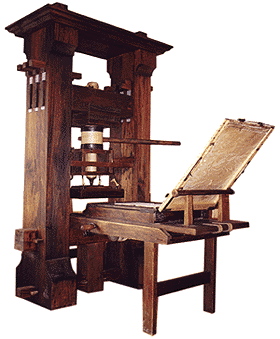
In 1450, the movable type printing press was complete and the first work printed was a German poem Gutenberg used as a showcase to try and attract investment. This new kind of press allowed for the creation of temporary templates, made up of pieces instead of one solid piece of wood or metal. The most notable and innovative of these pieces was the creation of the moveable type, the individual letters or common words that can be moved around and arranged into any configuration on the template. A moneylender named Fust and his son-in-law took note and provided Gutenberg the funds to open up a new print shop and the construction of two of Gutenberg's presses. 1452 the shop opened for business. The main profitable production was that of textbooks and Latin premiers, but the big money was in printing indulgences on behalf the local churches. 

With his involvement with the church once again, came the resurfacing of his old ideals of bringing literacy to the masses. But such an endeavor would require more financial backing from Fust who was reluctant as the shop was not turning out as much profit as he initially hoped. Faust would need to be influenced by an outside force. Gutenberg saw the opportunity in city of Frankfurt: Archbishop Aeneas (who later in life would become Pope Pius II), was a Papal Legate, there to negotiate a marriage between the German Emperor Fredrick III and the Princess Eleonore of Portugal.  Gutenberg came up with a proposal to receive official church blessing for his project, that what better tool to teach people to read then the Holy Bible which the church could distribute to their flocks:
"It is a press, certainly, but a press from which shall flow in inexhaustible streams.Through it, God will spread His Word. A spring of truth shall flow from it: like a new star it shall scatter the darkness of ignorance, and cause a light heretofore unknown to shine amongst men. Religious truth is captive in a small number of little manuscripts which guard the common treasures, instead of expanding them. Let us break the seal which binds these holy things; let us give wings to truth that it may fly with the Word, no longer prepared at vast expense, but multitudes everlastingly by a machine which never wearies to every soul which enters life."
With the Archbishops blessing and promises to act as distributor in hand he convinced Fust to loan him more money for his great project, and set one of his two presses to exclusively print what would later be known as the Gutenberg Bibles. The bibles were 1,286 pages of paper or vellum with Latin translation of the Hebrew Old Testament and the Greek New Testament written in various font types and ink combinations. And while some art and stylizing was printed, margins were left wide for additional, more personalized artistic accessory, including the rubrication (The oversized and stylized first letter of a new chapter). One copy in particular which now sits in Princeton University, was designed with the help of Gutenberg's old friend Master of Cards. Of the estimated 180 Gutenberg Bibles made, only 49 are known to still exist.
The church made good on its promise and sold the bibles as fast as the were completed with editions not only across Germany and France, the base of Catholic power, but as far off as England, Sweden, and Hungary. The Church was more then pleased with this new way to spread the word of god.
"All that has been written to me about that marvelous man seen at Frankfurt [sic] is true. I have not seen complete Bibles but only a number of quires of various books of the Bible. The script was very neat and legible, not at all difficult to follow—your grace would be able to read it without effort, and indeed without glasses." Letter from Archbishop Aenaes to lead Vatican Judge and Administrator Cardinal Carvajal
 And while the Church and those that bought the bibles, mostly lesser nobles and members of the up and coming merchant class, did use the book to spread the literacy of Latin, the expense and distribution of the books was not adding up for Fust. He sued Gutenberg and the Archbishop, in 1455, on accusations of misappropriations of funds and wanted his full investment back. Archbishop was dropped from the case, as any profits the Church made from the sales usually went on to directly fund the next one. The onus was put straight on Gutenberg who admitted that he may have mislead Fust about the profitability of the bible project, and that to him it was never about the money. The court gave the workshop and presses to Fust as compensation. He lived most of the rest of his life skating on the edge of poverty, at one point even being exiled from his home during a power struggle between powerful church magnates, he himself caught up as a pawn. But in 1465, Gutenberg, now an old man, was recognized for his achievements by the Church and given an annual stipend of money, grain, and wine, and made a member of the court of Archbishop Adolph Von Nassau as an advisor. He died in 1468 and was buried in a Franciscan church, which later was destroyed and the grave-site lost.

Gutenberg's contribution to society is unmistakable and his press is one of the cornerstone inventions of our technological rise. He is recognized by nearly every scholar and historian as one of the key figures in cultural development, and one of the Renaissance Era's greatest men. The Vatican Library, one of the greatest repositories of knowledge and written works in the world, credits him as an honorary founder. Gutenberg's press has lead to a vast and almost innumerable increase in the distribution/dissemination of knowledge and the spread of literacy among the middle classes. Countless have paid their respects to the man that made mass communication a conceivable concept. The great American writer/satirist Mark Twain once wrote of him:
"What the world is today, good and bad, it owes to Gutenberg. Everything can be traced to this source, but we are bound to bring him homage, … for the bad that his colossal invention has brought about is overshadowed a thousand times by the good with which mankind has been favored."

Monday, August 7, 2017

History at the Movies #2: Hacksaw Ridge


The Power of Faith and Conviction

How do you reconcile your spiritual and secular obligations? It is a question that still plagues large parts of American society today, and the answer is not easy at all to many; much to the ire of those that place more value on secularism over religious conviction or those that truly believe the word of God is always superior to the laws of man or societal norms. Hacksaw Ridge depicts this struggle that Corporal Desmond Doss found his own answer to, during one of the nations most trying and bloodiest times; and with those answers preformed one of the most miraculous events in military history. 

The movie plays out in two distinct halves. The first half is his fight for his spiritual beliefs against an American military, who at the time were hostile to the high ideals of living and expressing ones religious belief if they contrasted the status quo. The second half, is very real and physical struggle to do ones duty and have faith in God in the hellish chaos of the battlefield, but in doing so he become one of the greatest combat medics ever known and a recipient of the Medal of Honor.

Desmond Doss (played by Andrew Garfield) of Lynchburg, Virginia, was a carpenter and later military shipyard worker, and a devote Seventh-Day Adventist. Though he had a deferment exempting him from the draft due to his employ in the shipyard, he felt an overwhelming sense of duty and responsibility, as he felt it unfair he should be safe at home while others were in the line of fire. He enlisted in the United States Army as a Conscientious Objector, a designation usually applied to draftees, refusing to wield a weapon against another human being. His deeply held religious beliefs, as well as two traumatic incidents at home, forbade him from even potentially harming another human being, including even touching a weapon. His aim was to preform as a front line combat medic, to provide healing and comfort to those suffering on the battlefield. This view severely frustrated not only his unit but also sergeant Howell (played by Vince Vaughn), Lieutenant Glover (Played by Sam Worthington), his superiors.
"I knew if I ever once compromised, I was gonna be in trouble, because if you can compromise once, you can compromise again."
Lieutenant Glover and Sergeant Howell

Through beatings from his fellow recruits (who Doss refused to rat out), pressure from his sergeant (who at first was enraged by Doss, but then felt sorry for him), and an attempt to have him declared mentally unfit for service (which the army psychologist rebuked to Glover), Doss refused to give up his convictions and his place in the service. Finally after refusing to pick up a rifle as a direct order from the company colonel, Doss was arrested and set to be court martialed for disobeying a direct order. In dramatic Hollywood fashion Desmond's father, in his old WWI uniform, shows up in court with a letter from his former lieutenant, now a general with considerable influence, excusing Desmond and reaffirming his status as a Conscientious Objector. The truth of the event was less monumental: Desmond father contacted chairman of the church's War Service Commission in Washington, Carlyle B. Haynes, who in turn threatened to start on independent investigation into the matter. This prompted the case to be dropped before the judges convened. And so Desmond goes off to war.
"With the world so set on tearing itself apart, it doesn't seem like such a bad thing to me to wanna put a little bit of it back together."
The movie skips ahead in Desmond's career, not even acknowledging his roles in the Battles of Guam and Leyte. We are fast forwarded to the Battle of Okinawa. Okinawa, the culmination of the American Island Hopping Campaign of the Pacific theater of WWII, was an 82 day long battle to take the island everyone saw as America's gateway to a final invasion of Japan. In April 1945, Lieutenant Glover and Sergeant Howell's 1st Battalion, 307th Infantry, 77th Infantry Division, including Desmond Doss, were assigned to take a ridge and plateau of land on top of the Maeda Escarpment, nicknamed Hacksaw Ridge for the sheer brutality of the fighting has been up there and viscous wounds of previous soldier's failed attempts to take it. After a day and a half day of fighting, and suffering heavy casualties, they too were forced to retreat back down the cliff. But Desmond was separated from the general retreat going back for one of the wounded. After recovering the man and lowering him to safety, Doss made the decision to stay up on the ridge all night trying to bring back as many of the wounded as possible, including a handful of Japanese soldiers. Each new rescue attempt came with its own challenges; Japanese patrols, sniper fire, the enemy tunnels that honeycombed the entire area, improvising tourniquets and other temporary treatments. And though exhausted after each rescue implored God to give him the strength to get "...just one more!". In all he is credited with the rescue and recovery of 75 wounded in one night, including Sergent Howell, even while wounded himself 4 times.

The Maeda Escarpment was about half as high as the movie portrayed it

After he himself was finally rescued from the ridge and treated for his wounds he became an instant hero to his fellow soldiers, especially those like Glover, that had previously mocked him for his beliefs. A few days later Glover's men would attempt a second attack on the ridge, but this time refused to head up until Desmond had led them in prayer. That day they would take the ridge, but not before Desmond Doss's last act of bravery. A Japanese grenade landed near were Doss and Glover were standing, Doss, seeing the grenade, shoved his Lieutenant into a hole before he himself was blown back by the blast. He would sit out the rest of the war convalescing from his injuries.

Corporal Desmond Doss Receiving the Medal of Honor from President Harry S. Truman

With the exception the some details surrounding his wife Dorothy (played by Teresa Palmer), and the aforementioned court martial, the movie by all accounts is as near perfect accuracy you get in a historic biopic. In fact several other rescues that occurred that night were omitted from the film because director Mel Gibson thought the audience would never believe it, even though they really happened. And of course, as with Saving Private Ryan, you have the usual calls (from the usual ant-war sources) against so called war glorification and overt graphic violence, but again just like with Ryan, these editorials have been rebuked by experts and the men that were there. There is no doubt that director Mel Gibson's religious charismatic style of film making is all over the piece, but it not only works is wholly appropriate. Andrew Garfield is wonderfully likable as Doss with his aw shucks country attitude and thick southern accent. Sam Worthington's Glover is a character who your inclined to dislike at first but grow to understand and respect, making the transition very smooth and subtle through the film. But to me the most memorable performance had to be Vince Vaughn as Sergeant Howell, Doss's drill sergeant and later platoon leader. The role is a far cry from what we are use to seeing from Vaughn but he fit the bill very naturally, selling his role to me in his very first scene and like Worthington making a wonderful transition in how you view the character.

The movie's message is to find strength in conviction, and that strength need not come from muscle of the arm or the barrel of gun; is one of surprising inspiration. There was no wringing of the hands, no questioning one's faith; this was of a man whose beliefs were absolute to him. It is a nice change to see a movie were someone so secure in their beliefs that nothing, not society, military, or war, will change them. And that standing, unquestionable, to what you believe can yield great achievements. Too many stories now a days insist that a hero second guess himself, or go through some cathartic moment to achieve greatness. Desmond found is conviction and his mettle before the events that made him a hero, and it is his unwavering faith in God that helps him achieve the impossible

On a side note, the making and success of this movie is a bit of a redemption story for it's director Mel Gibson. For a few years now Gibson had been shunned by Hollywood, made a pariah by his several deplorable actions that he has since tried to make up for. Over the years he has tried with apologies, charitable works, and through the advocating of friends like Jodie Foster and Robert Downy Jr., to get back into the public's good graces. Many saw this movie as his last best hope of returning to the film industry. And it may have been the reprieve he was seeking.Try as they might his critics and the Hollywood elites could not bring themselves to disregard this story that had to be told, and was told brilliantly. Praise was deserved and had to be heaped upon the man they loved to hate this past decade. And with the exception of a few newspaper editorial's damming Gibson for all eternity for his past indiscretions, no matter what he does. The majority of the public looks like they are ready to move past it. What this means for the future career for the man who not only brought us this magnificent film, but other greats like Braveheart and Passion of the Christ, only time will tell.

No matter how you may feel about Mel Gibson the movie is well worth a watch from both a inspirational stand point and (more importantly as this blog is concerned) historical stand point. It is extremely well made, well acted, and has awe inspiring shots and dialogue. So for now, put the kids to bed, butter up some popcorn, and marvel at achievements of a man who had God on his side during a time that almost seemed godless.

Badass Women of History #7: Queen Tamar

Modern day Georgia There is large strip of land, just south of Russia proper, north of Turkey, and in between the Black and Caspian...